I woke up the next day worried that the hanging coffins would be as jammed full of people as the guest houses were, so I wanted to tackle the day early on. I had been here previously and tried to beeline to the location of the coffins but we got stopped, and were sent back to wait in the massive line of people paying the tourism entry fee, and was told we had to hire a tour guide. We went to the tour guide office I went to last time, and there was two people I didn’t recognize inside, as suspected. We said we wanted to go to the coffins and we were given a very young guide who barely spoke any English, which was fine because I could play tour guide for Mark’s experience. We took a shortcut through town to the cemetery entrance and we walked past the local meat market and Mark pointed out the whole pig’s head, something they shelter people from typically at an American grocery store, because heaven forbid you are aware that the food you are eating was once a living creature. We were told by the hotel staff that there was a wedding in town, and sure enough when we passed by the church there was a bunch of people wearing Catholic wedding garb, which meant we wouldn’t get a glimpse inside the church this time, but we were at least invited to the feast afterwards but we were eager to get out of Sagada. This time with a guide in front of us, we were allowed entrance into the cemetery. The tour guide took us on a path and there were so many people he literally stepped up on one of the graves to avoid the masses. We had some broken conversations and walked past a selfie point, which Mark and I both declined and instead just took a photo of the view, and then tried to proceed down the stairs. There was a rock wall and people with harnesses climbing it, and we pushed past that too towards the hanging coffins themselves. We got clogged in human traffic on the only path down, and once we made it to the site there was a group of maybe 15 people standing in front of it having their photos taken. Mark handed me the metal container holding Jim’s cremains and I opened it up and poured a little into my bare hand, and put a good grip on it. Once the sea of people parted I walked up and Mark started filming, and I dispersed some of the ashes onto the ground on the other side of the fence, and got out of the way for the next van full of people to get their photos. We took some photos of the coffins themselves and followed the guide where he tried to show us some other hand carved caskets. We walked past a bunch of coffee plants, and Mark said it would have been perfect to put some of his ashes into a coffee plant, as the man was quite hooked on those beans. Our guide pointed out some coffins very high up on some other rocks that I hadn’t observed before. They believed the higher up you were, the easier it was for them to get to heaven.
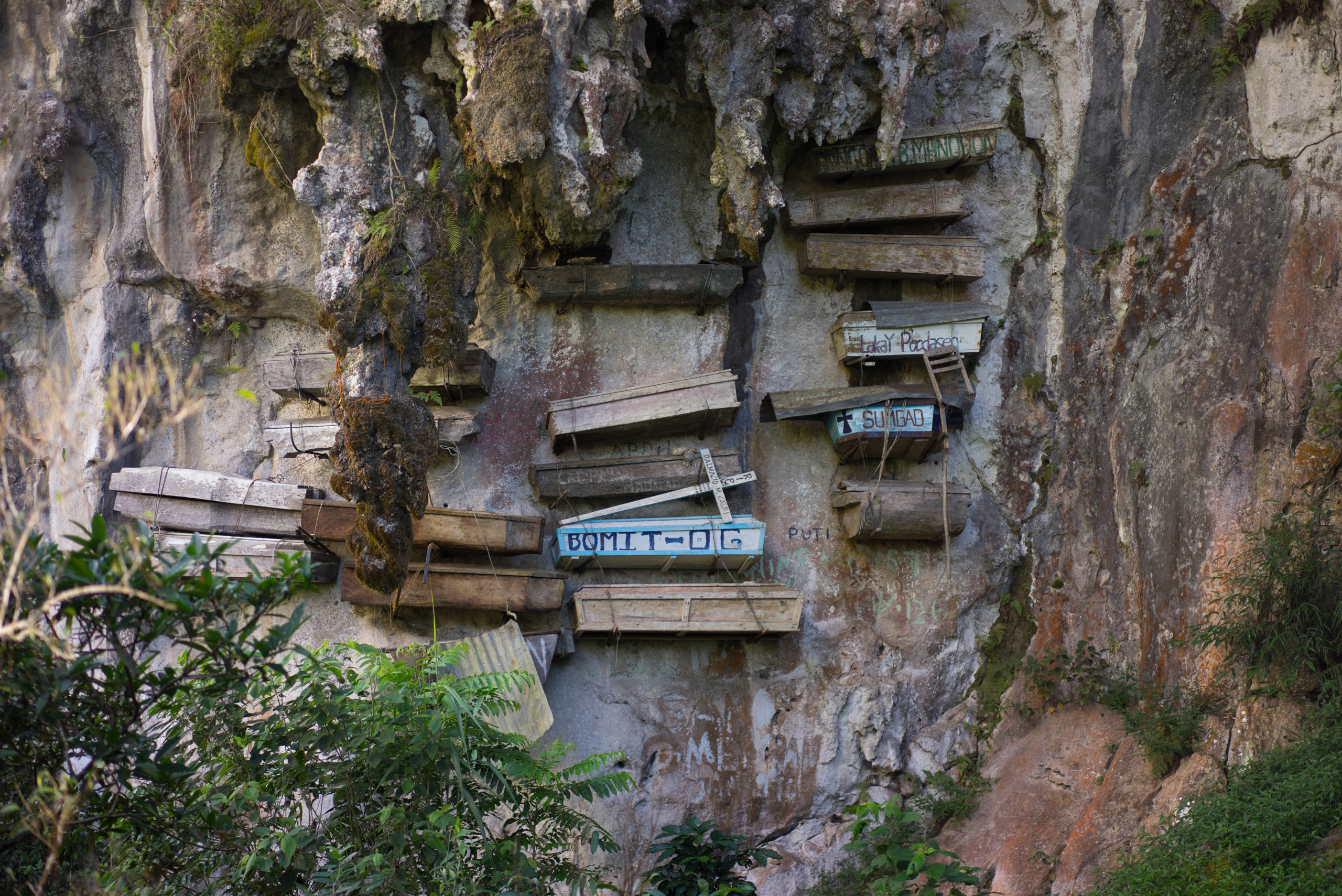
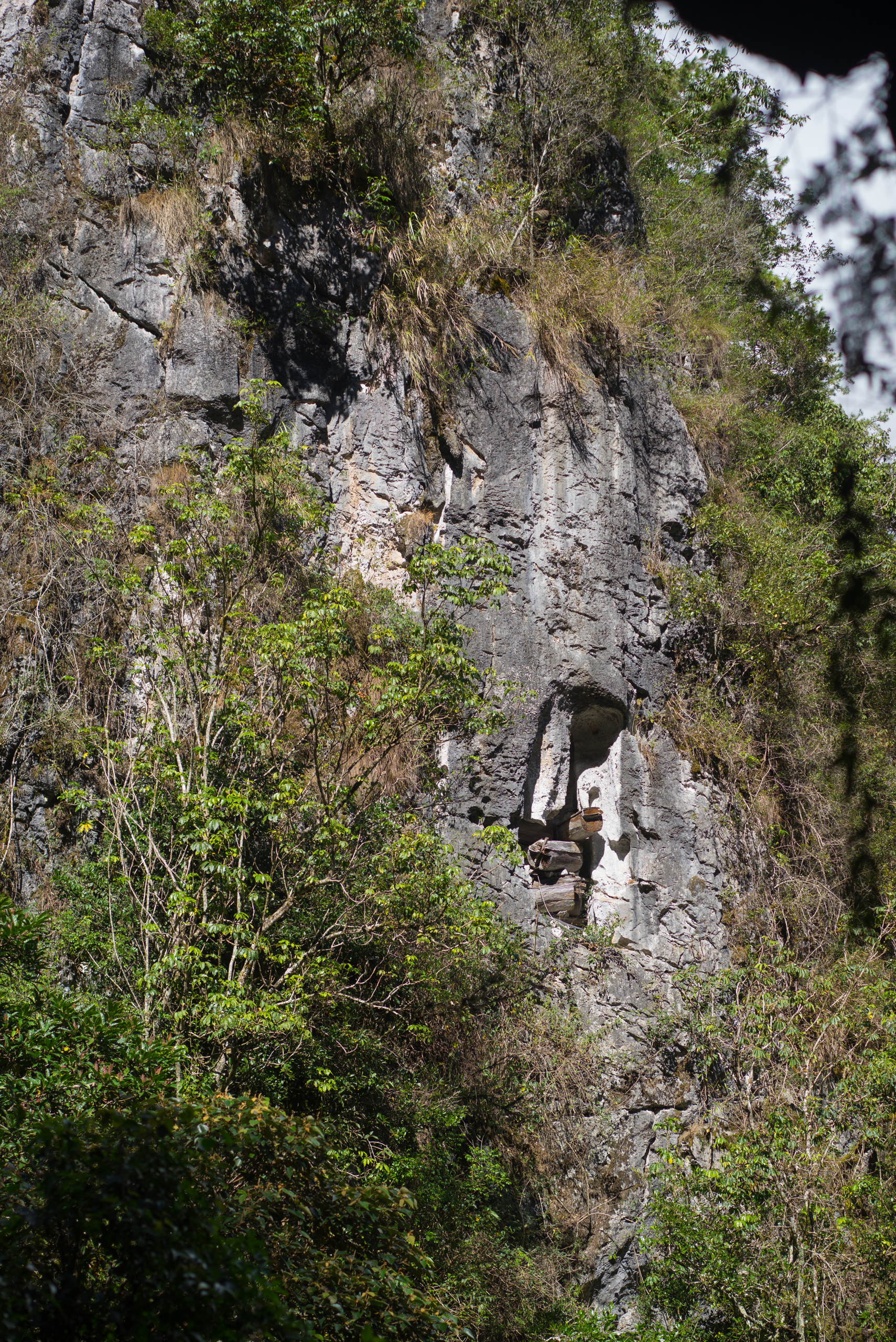
When a person had died, they would celebrate the life of that person with them in their house, and I mean “with” them when I say that. They would sit the dead body down in a chair, and strap them to it so they wouldn’t fall out, and people would come to the house and drink and eat and remember what that person meant to them and their lives. I recently read that the bodies were smoked to delay it from rotting, if you wonder about eating food in a house with the smell of a rotting corpse. The elders would actually carve their own coffins out of local wood, and paint their names on it. After the celebration of life concluded, the family would typically have to break the bones to get the body into the coffins typically only one meter in length, and place them in the fetal position. These traditions are estimated to be about 2000 years old, so they would use what they had to raise the casket up the side of the cliff, and prevent them from tumbling back down. I also recently read that sometimes fluids would drip out of the bottom of the casket and the people hanging them would welcome the splats believing it would bestow them luck. I was told they used to do a death scream at the wall during the hanging, and the sound would fill the area known as “Echo Valley”, though due to tourism most of their traditions have stopped. Tourists aren’t a fan of death screams, of the smell of rotting human, or being rained on from a dead person, so now the coffins mostly just serve as a source of income for the economy. I read one tour guide still hopes to be buried up there, and go from tour guide to tourist attraction, which is an admirable goal. I also heard that due to the demand for being on the walls, there was certain criteria that had to be met to be placed up there, such as being a certain age and a member of the barangay for their whole life, with a certain number of children.
We continued down the hill through some thick mud, and I tried to look for the cave I saw last time that had some bones and remains at the bottom from when one of the coffins collapsed, but we were unable to see it, so we went back up the hill and stepped aside as the people kept coming in waves to see the coffins. We made it back up and through the town, but needed to break our big bill to pay our tour guide, so we went to get some food but still had too large of a bill so we just tipped the guy instead so he could get on with his day and assist more tourists, because it was obvious there were a lot of them there. The food was far better than what I suffered through the previous night, and we headed to our rental vehicle to continue further north. I remember overhearing a kid asking his father why it was so hot that day, because a lot of “lowlanders” come to the mountains this time of year to escape the heat.
We backtracked down the path a little bit in the car and made it back to the main road, and began our drive to Kalinga, the province further north than the cleverly named Mountain Province that Sagada was located in. The route took us along the only road in the area, and was full of large chunks of earth that had fallen from landslides, as Stevie Nicks got stuck in my head. We saw the large metal spikes that they would drive into the side of the mountain behind a large net to keep rocks from falling, and construction workers scaled the steep edge like mountain goats.
The reason most people to go to Kalinga is to go to Buscalan, the tattoo village, where Whang Od lives, the 106 year old mambabatok practicer calls home. This is the traditional style of tattoo in the region, where the artist uses a piece of wood dipped in ink and hammers it into the skin of the client. When Jim had visited many years ago, it was a nice quiet village with no power, and was beautiful and very relaxing. When I went in 2019 I had no knowledge of Whang Od, or anything about tattoos, I just was told it was a really quiet remote mountain barangay and I should experience it. Upon my visit, we were extorted upon entry, and found out their economy thrives off of tattoos, weed, and guns, mostly for tourists that come from all over the Philippines, as well as plenty of westerners to get the famous 3 dot insignia of the old lady. There was nothing quiet or cute anymore so we were quick to leave the next day. The reason I mention this is because on our way up, we were stopped several times asking where we were going, and due to the color of our skin they assumed we were headed to Buscalan. I insisted no, we were going to Poblacion, to see Sleeping Beauty, Sumadel, and all things not related to Buscalan.
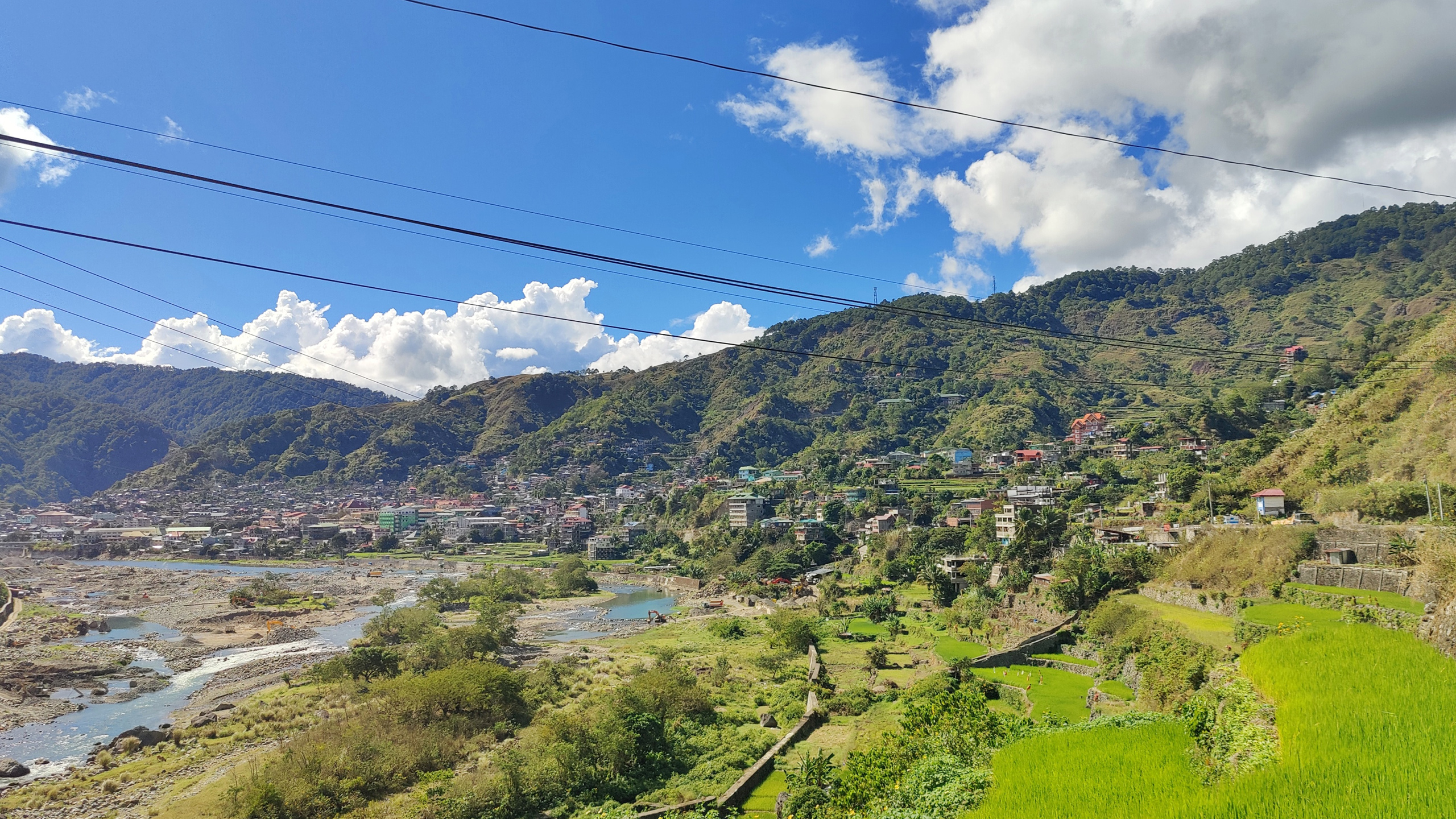
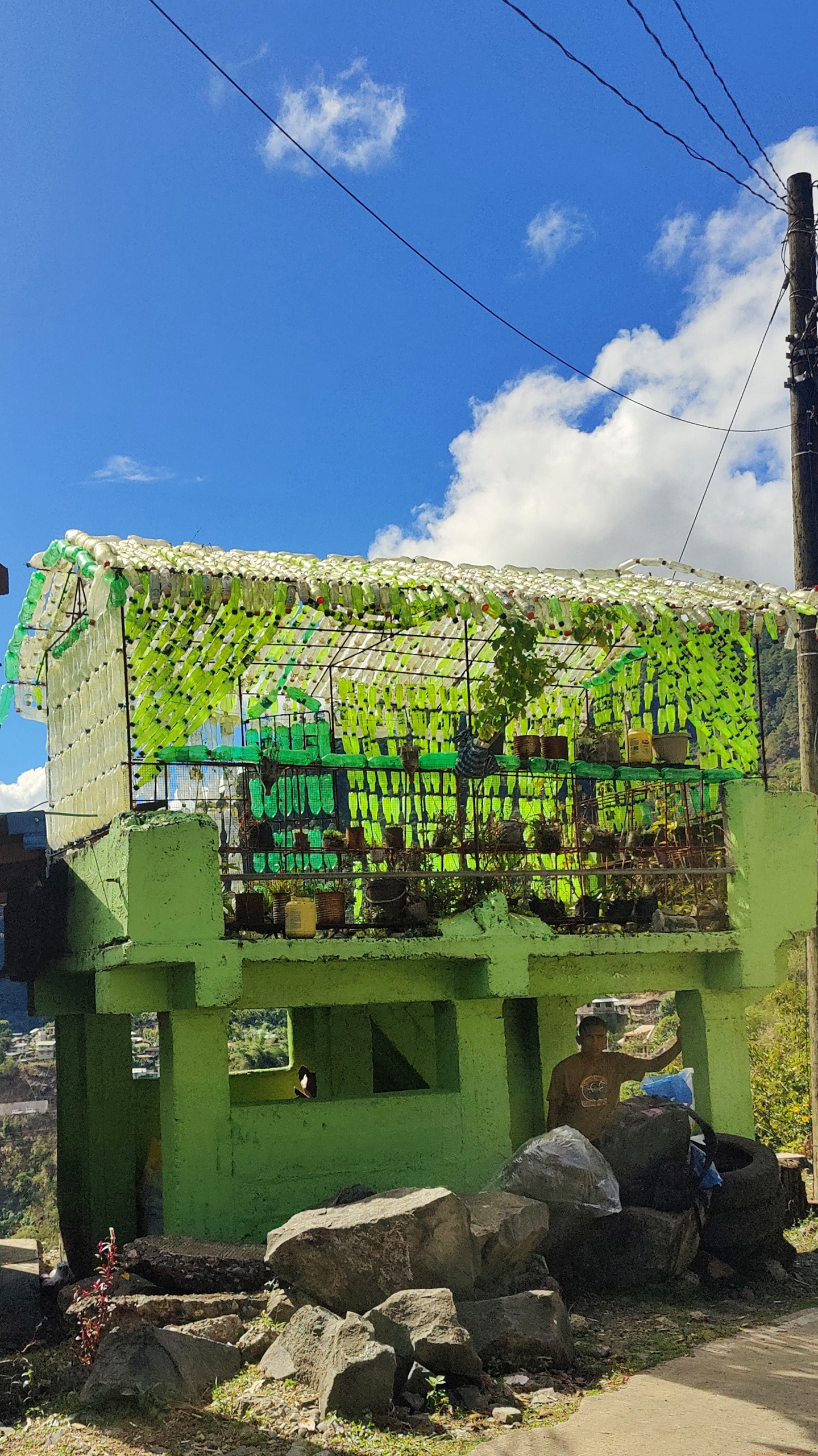
While we were driving we would stop to look over the cliffs at the big views, and various terraced hillsides, some made with mud and some made with concrete. We approached a big bend in the road and I saw something very bright green in the distance, and I said, I sure hope that is a house made out of Mountain Dew bottles, and as we got closer I was not disappointed. Mark decided it would be appropriate to purchase and consume a radioactive green Dew, so we found a pretty decent little store and stopped and scooped up a Dew and some lumpia. After Mark took a sip, and made his best “Ahh” face, we pressed on up the winding roads, past a couple more police checkpoints, until finally we made it to Tinglayan.
The main town was just up the road, and we arrived and parked at a place where I knew we could actually get some phone signal. I downloaded a couple photos of people singing karaoke from last time I was there, and went searching. The first truck that passed us rolled down it’s window and smiled a big red moma smile. Moma, also known as betelnut, is a red nut that serves as a stimulant, stains the teeth red, causes them to rot and fall out, and can even cause diabetes. There were many signs in the Mountain Province that said “no spitting of moma.” This red mouthed individual asked us if we needed help, and I showed him the photo of the man I was looking for. “Ah yes this is Francis, he lives right over there” and pointed to where his house was, gotta love those small town vibes. We walked up to the house and he pointed us to go down the steps then I remembered where we stayed before, and walked up to the house and his nephew was there, but they told us Francis went to Buscalan, presumably to help guide westerners to get tattoos. We sat down on the bridge next to moma mouth and he offered us some betelnut, and said “it’s good for red teeth” which he was not incorrect about. I showed him the photo of the old man for whom the birthday party was for last time I was there, and he said that was his uncle. We talked for a little bit and we told him we were going to go make the trek to Sumadel, a quest that was made last time in the hunt for a legit remote quiet mountain barangay.
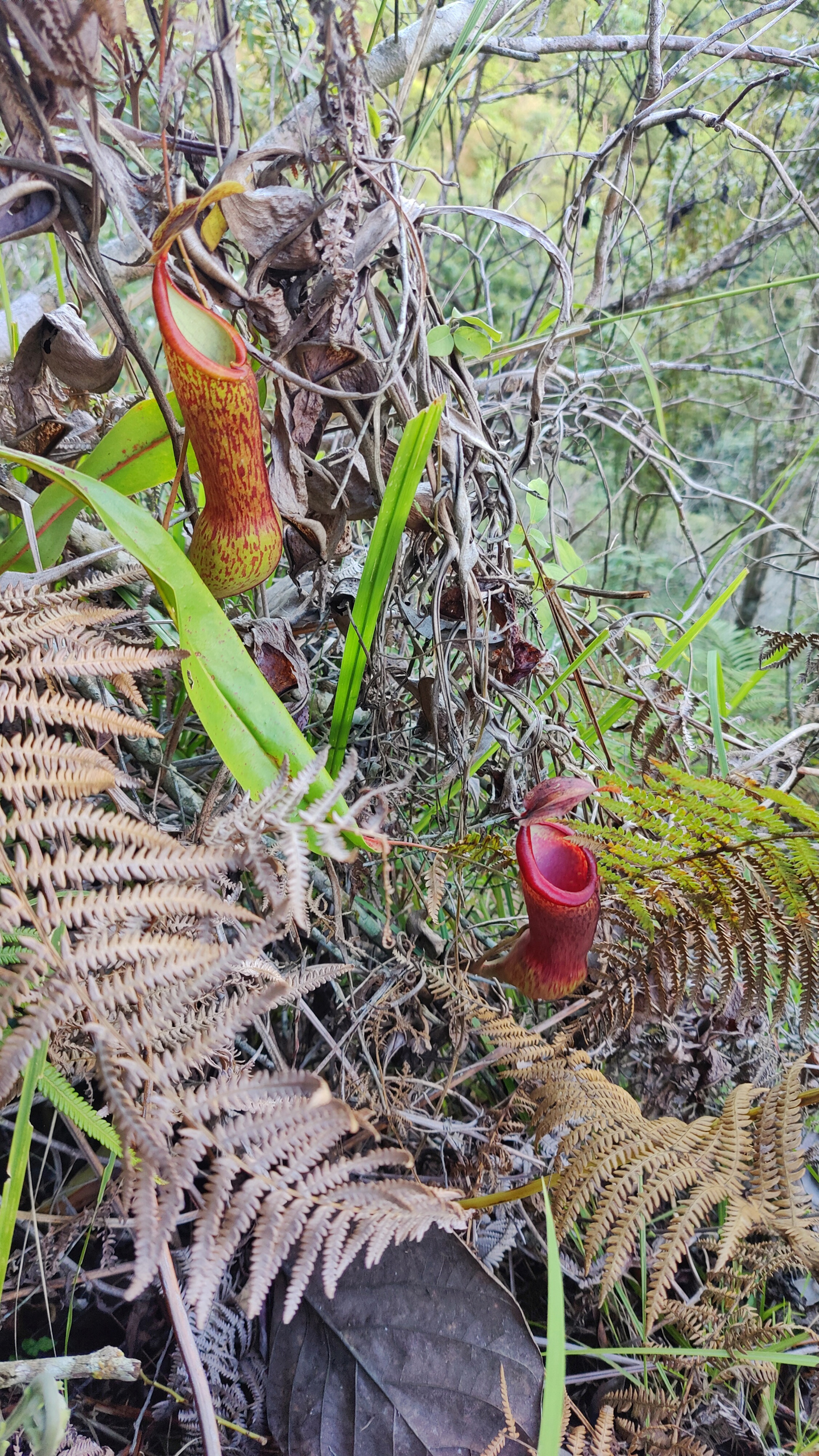
Mark and I headed through the town and made all the local girls giggle and say hello, good sign you aren’t in a touristy area. People looked up from what they were doing and looked at us puzzled and we waved and smiled and headed to the city hall. I somewhat remembered the path, and we found it but shortly after finding it ended up in someone’s house, so we turned around and tried the other way. The path was very narrow and muddy, and quite vertical, which made for great views of the valley behind us. We stopped in awe when we came across some pitcher plants, a carnivorous plant that always fascinated me as a child, and was a little surprised how small they were. This day was to be our only day in Kalinga, so even though it was about 3pm when we started, it was do the hike that day, or not at all. The path was rather rough, and extra sloppy, and we had some rickety cattle guards to scale over on our way up, but everything went fine until Mark made a comment about there not being anywhere else to go, so me getting ahead wouldn’t be an issue. After he made that remark we found ourselves at a 3 way split in the path. The first path we tried ended up in a dead end, but we found a flipflop stuck in the mud, so we thought maybe it was the right way, but we doubled back, and tried the second path. The second path was a chute of pure deep mud, and I was grateful to be wearing sandals even though I was up to my ankles in thick muck. After the muck the path split again and went straight up hill, and we almost fell over and made it as far as we could until the path was so overgrown we figured we had to be going the wrong way. We doubled back again and Mark practiced his Ninja Warrior skills to try and keep his socks out of the mud. We thought maybe we should go back, but being stubborn and with nothing else on the agenda for the evening, went down the hill that looked like a mudslide and found some barefoot human prints, and like that we were back on the path again. Some places got extremely narrow, and aspired less confidence in Mark, until we came across some random concrete steps. These would not be the only concrete steps we would discover on our way up the mountain, which begged the question, what kind of superhero lugged all these bags of cement up this mountain to make these stairs, a legend we uncleverly referred to as Concrete Joe. There were so many times the path would abruptly turn into concrete stairs, a true testament of the abilities of the working Filipino. The path was pretty tricky without bags and just carrying ourselves; it’s hard to imagine the amount of trips taken carrying sacks of concrete up and down the mountains to make all these stairs happen, but we were very grateful to have them as everything was a muddy disaster. Up and over one mountain, across a small bridge, then up and over the next one, but the sun was starting to go down in a hurry. The impending darkness changed the vibe of the hike, and made the rests an absolute minimum.
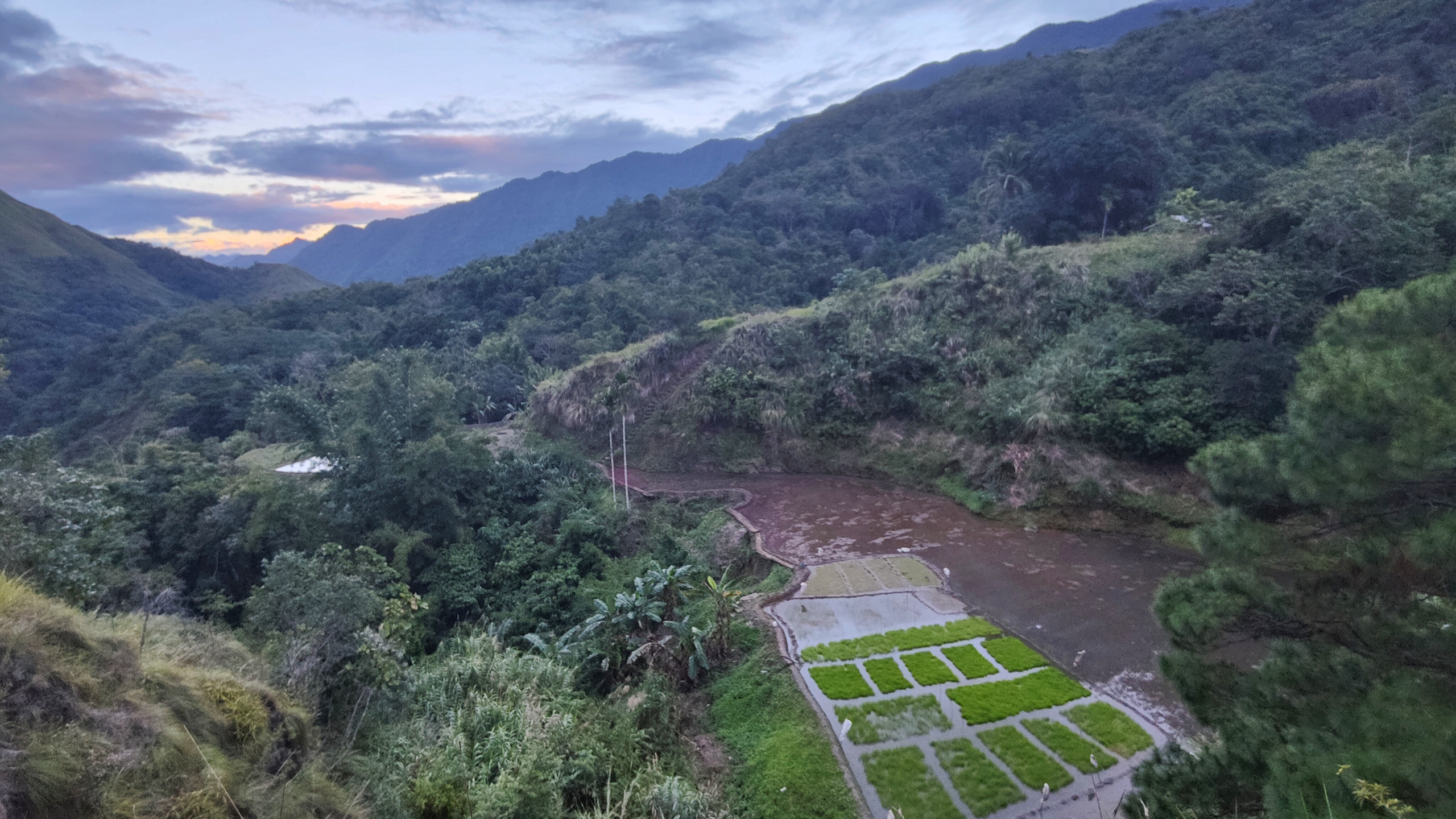
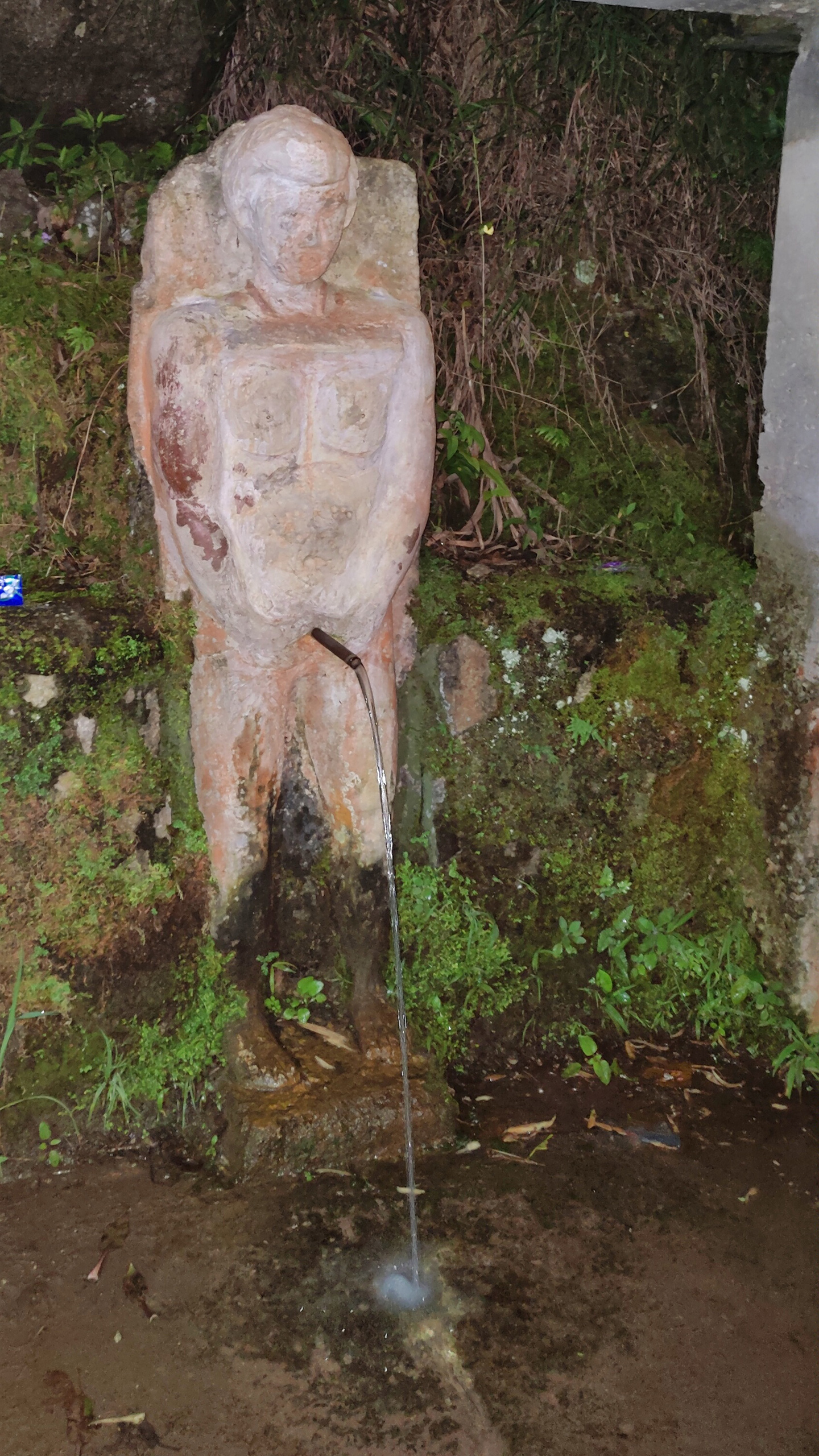
As it started to get really close to full on nighttime, we encountered a local just up the trail from us, walking barefoot and carrying several pieces of wood each at least 3 meters in length on his shoulder. He walked uphill carrying this weight barefoot, and Mark and I slowed down for a little bit because we felt it would be rude to pass him. Eventually he caught on to us being behind him and let us pass, and Mark let out a big ol American “Thank You” to which he just seemed even more puzzled why we were out there. After passing him, it was so dark Mark wanted to use his headlamp, but I was struggling to see with it on so I walked ahead to use what light my eyes could still detect. After zigzagging up a bunch of terraced fields, along the path that was used to maintain the individual ponds if you would for a lack of a better term. There were many things being grown, most obviously to me where the little chili pepper bushes, aside from the rice. Eventually we made it to what Mark interpreted as the goal of the hike, long before we got lost and dark, Mr Sumadel, a statue of a man holding onto a metal pipe between his legs where fresh water flowed out. Initially we planned to grab a filtered water drink from the top but when we arrived there, but the local man carrying the wood caught up, plopped down what he held, and exhaustedly began to cool himself off by bathing in Mr Sumadel’s water stream. It was super dark at this point and Mark asked if we were even going to drink his pee like I suggested earlier in the day, to which I replied we had no time and we got to enjoy a local properly bathing in it instead, though it was too dark to properly capture that moment. From Mr. Sumadel we were pretty much in the barangay proper, Sumadel 2. There was only a couple of lights that could be seen, mostly produced by younger people’s cell phones. Up and up we went into the village, when we suddenly showed up to a group of people gathered in the dark. They were baffled why we were there, and tried to communicate with what words they had, and we asked them the direction to get to the road. They asked if we would have a car when we got to the road, and what our plan was, and we said we will call someone when we can get signal, unknown to me at that time that the number of Francis saved on my SIM didn’t actually save to my phone. We stumbled up tons of stairs, and missed many views of the terraces lining the side of the mountain, and walked past tons of small tin roofed shacks, frequently setting dogs into barking furies as we passed. People gave us odd looks but we gave nice waves and kept going up and up, through Sumadel 2, past Belong, until finally we found a super steep path that had collapsed. We pulled our weight up and made it to the top and saw a couple of combustion engine vehicles, which led us to believe we must be close to the road.
Though we found the concrete road, and it was downhill, we still had an immense journey to reach the proper road that sometimes has vehicles on it. Last time I did the hike we hitched a ride in the back of a worker truck, but I figured since it was dark we would encounter some problems. I wish I recorded the elevation and distance of the entirety of the hike, but the downhill to the main road seemed to take even a couple more hours. Thankfully we had snacks with us, and there was tons of mountain water flowing that we could drink, so we knew we could make it, though our legs were feeling the mountain passes. We finally arrived to the “actual” road, and it seemed the only vehicles we saw were scooters going the other way from where our car was parked. We eventually came across a house that had 2 vehicles parked in front of it, and two young girls were on the porch on their phones. Mark asked if we should ask them for a ride, and I came back with what’s the worst that could happen. We asked if the girls spoke English, shy and giggling they called their mother from inside the house. She came out and we explained we were trying to get back to Poblacion, quite a while down the hill and it was already quite late, and the mother went off to find her husband working in the field. Mark seemed unsure of what was going on but we sat down and waited, and the husband showed up, looking decently intoxicated, and we were informed that he could not drive, and they were going to find “their driver.” While looking for the person who was to soon be our chauffeur, the mother made some coffee and brought some bread and mayonnaise, then proceed to apologize to us that they had just eaten and was so sorry she didn’t have more food to offer. Mark was taken back by this offering, a person apologizing for not having more food for strangers who showed up at their house in the middle of the night looking for a ride back into town, but that’s just how hospitable people are in this part of the world. Being allergic to bread I had to decline, and I tried to sip on some of my Kalinga coffee to be nice, though I no longer drink caffeine. The father asked us about taking home Filipino wives, and suggested Mark could get a second wife, then awkwardly called his daughters over to take photos next to us. The father was familiar with Francis, and spoke highly of the man. The driver showed up and we all got into the car and took the long drive back to where the rental was parked, near Francis’ house.
It was pretty late, and the gate at Francis’ house was closed, and there was no way for me to get his number due to it not actually saving to my SIM card, so we crossed the bridge made out of scrap left behind from World War 2, and headed to Luplupa. There are no roads leading to Luplupa, or Old Tinglayan, just paths to walk on foot past farm animals and more Christmas carolers. We wandered about in search of the Luplupa Inn, and at one point was sitting down on some steps feeling pretty defeated and considered sleeping in the car, when an older woman heard us and came out to investigate. Though she was just about to go to bed she came and helped us find the Inn, and grabbed some help and they told us we could indeed stay there that night. The hospitality rained down on us as she asked if we had eaten, or if we wanted any coffee, but we said they had already done so much, and we would be happy just to sleep and not need any further services. She asked us what time we wanted breakfast and we agreed on an hour, and she left us the keys to the whole Inn ourselves, without any paperwork or money. Mark and I enjoyed high pressure cold water mountain showers and crashed hard.
Continue to the next page for additional photos from the day